
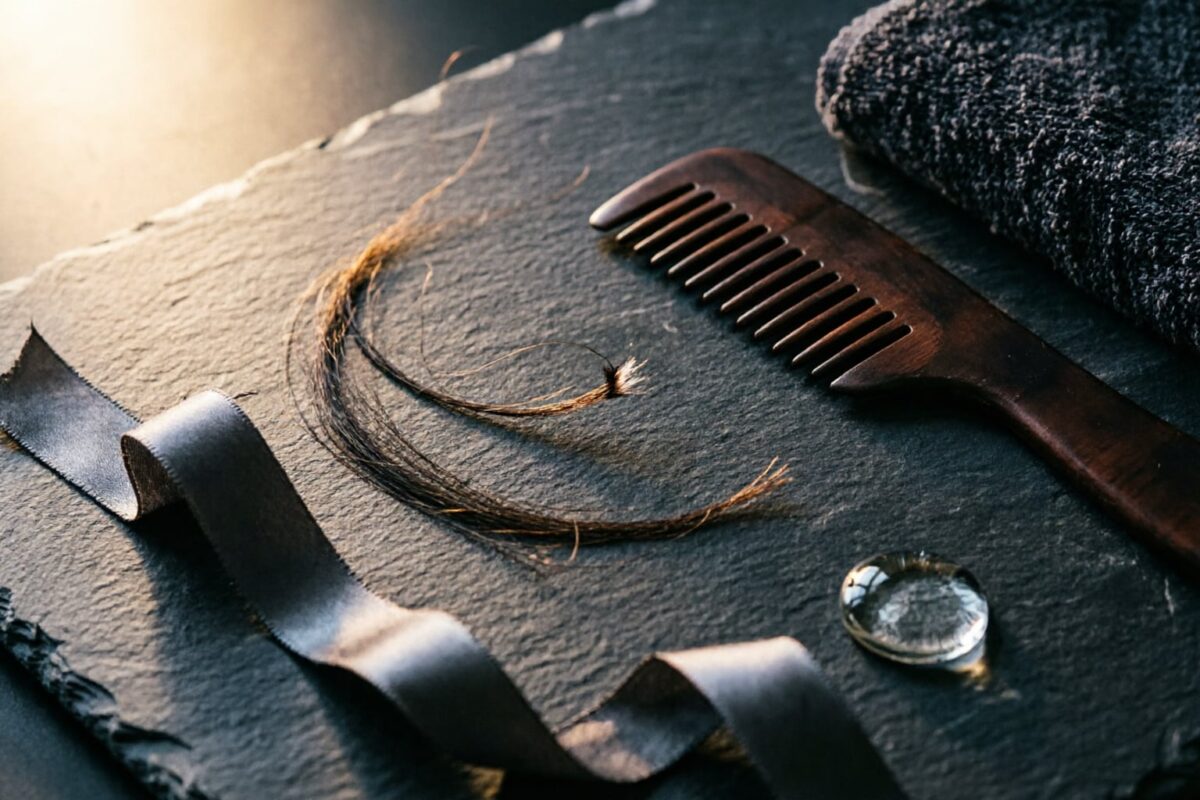
Hair that appears on the pillow, in the shower drain, or on a brush is not automatically broken hair. Shedding begins at the root and often includes a tiny white bulb. Breakage occurs along the hair shaft and leaves uneven or split ends. The difference matters because friction, heat, and chemical damage require a different response from a medical cause of hair loss.
The American Academy of Dermatology says hair is especially delicate when wet and recommends a wide-tooth comb, gentle towel drying, lower heat, and protection from styling tools. Those are not cosmetic extras. Repeated mechanical stress can accumulate over time, especially around the hairline, crown, and ends where brushing and heat are concentrated.
Breakage or Shedding?
Look at the strand rather than the amount. A shed hair usually has a rounded root end with a small white or translucent bulb. A broken hair ends abruptly and may look uneven, frayed, or split. Short pieces around the crown, many split ends, or a section that becomes thinner only along the lengths are consistent with breakage. Diffuse thinning at the scalp, patches of missing hair, or a widening part is more concerning for a shedding or scalp condition.
People normally shed hair, so one shower is not a useful measurement. Look for a change from your baseline and whether the pattern persists. The AAD lists many causes of hair loss, including hereditary hair loss, illness, childbirth, menopause, medication, thyroid problems, and alopecia areata. Sudden, patchy, painful, or inflamed hair loss should be evaluated rather than treated with another conditioning mask.
| Breakage pattern | Likely source to inspect | First practical change |
|---|---|---|
| Split or white-dot ends | Heat, brushing, old damage | Trim the weakest ends and reduce direct heat |
| Broken pieces near the crown | Tight elastics, rough detangling, pillow friction | Loosen hairstyles, comb gradually, consider a silk pillowcase |
| Snapping during detangling | Dryness, buildup, rushing through knots | Condition, detangle wet hair with a wide-tooth comb, start at the ends |
| Irregular patchy loss | Possible medical or scalp condition | Do not self-treat; see a board-certified dermatologist |
Reduce the Load on the Hair Shaft
Start with the steps that create the least extra spending. Stop ripping through wet tangles. Apply conditioner where the hair needs slip, divide the hair into sections, hold the lengths above the knot, and comb from the ends upward. Wrap hair in a towel or cotton shirt instead of rubbing it vigorously. Use a gentle, flexible hair tie and rotate tight hairstyles so tension is not repeated in the same place.
Limit direct heat and use a lower setting. A heat protectant is useful, but it does not make unlimited high heat safe. Keep the tool moving rather than holding it against one section. For blow-drying, stop when the hair is dry instead of continuing to pass heat over the already-dry ends. The AAD also recommends protecting hair from sun and chlorine, especially when it is color-treated or frequently exposed to water.
Chemical services add another variable. Bleach, permanent color, relaxers, and perms can change the hair’s structure, especially with overlapping applications. Follow the product or professional instructions and do not combine services solely to fix a color result quickly. A protein cosmetic may temporarily improve the feel of damaged hair, but it cannot reconnect a broken strand or reverse a chemical burn.
The protein treatment guide explains why the popular term “protein overload” has limited diagnostic value. Stiffness can come from protein, polymers, heat damage, or product buildup. Change one product at a time and judge how the hair behaves after it dries, not only how slippery it feels in the shower.
Repair What Can Be Repaired
A split end cannot be permanently sealed. Trimming removes the weakest section and prevents the split from traveling farther up the strand. You do not need to remove all damaged hair at once unless a professional recommends it. A small trim, fewer high-heat passes, and gentler detangling can make the remaining hair easier to manage while it grows.
Choose conditioner by behavior rather than a dramatic label. If the hair is difficult to comb, conditioner should improve slip. If it is limp and coated, use less product and clarify only when buildup is likely. If it breaks when dry, inspect the brush and hairstyle before adding a heavier mask. The goal is a repeatable routine with fewer competing layers, not a shelf of rescue products used in the same week.
Skip dry shampoo when the scalp is itchy or the hair already feels rough and coated. Dry shampoo can help temporarily absorb oil, but it must eventually be washed out with regular shampoo and water. The 2026 dry shampoo comparison covers how to use it without confusing temporary oil absorption with repair.
Flakes around the scalp are not necessarily breakage. Dandruff, product residue, and dry scalp can create visible particles. The dandruff treatment guide explains the difference between scalp flaking and damaged hair ends. If the scalp is inflamed or the hair is falling from the root, treat that before buying a hair-strengthening product.
When to Get Professional Help
See a board-certified dermatologist for sudden hair loss, expanding bald patches, scalp pain, scaling, redness, or hair loss that continues despite gentle care. Also seek help when hair loss coincides with a new medication, significant illness, poor nutrition, or symptoms affecting the whole body. A cosmetic routine is not a substitute for diagnosis when the problem begins below the surface.
People who wear braids, weaves, extensions, or very tight hairstyles need to pay particular attention to tension, weight, and duration. If a style hurts, pulls at the hairline, or leaves sore spots, remove or loosen it. The skincare ingredients guide is not a hair-care source, but its basic principle applies here: identify the function of the product before assuming a longer ingredient list will solve the problem.
The decision rule: inspect the ends, reduce friction and heat, trim the weakest hair, and keep one simple conditioning routine. If the scalp is the problem or the hair is shedding from the root, stop treating it as cosmetic breakage and seek the right diagnosis.
Updated November 5, 2026. Written and edited by the BeautyPick Lab editorial team. This article summarizes cited public guidance and does not represent firsthand testing or medical advice.
Sources
- American Academy of Dermatology. Tips for Healthy Hair.
- American Academy of Dermatology. Hair Styling Without Damage.
- American Academy of Dermatology. Causes of Hair Loss.
