
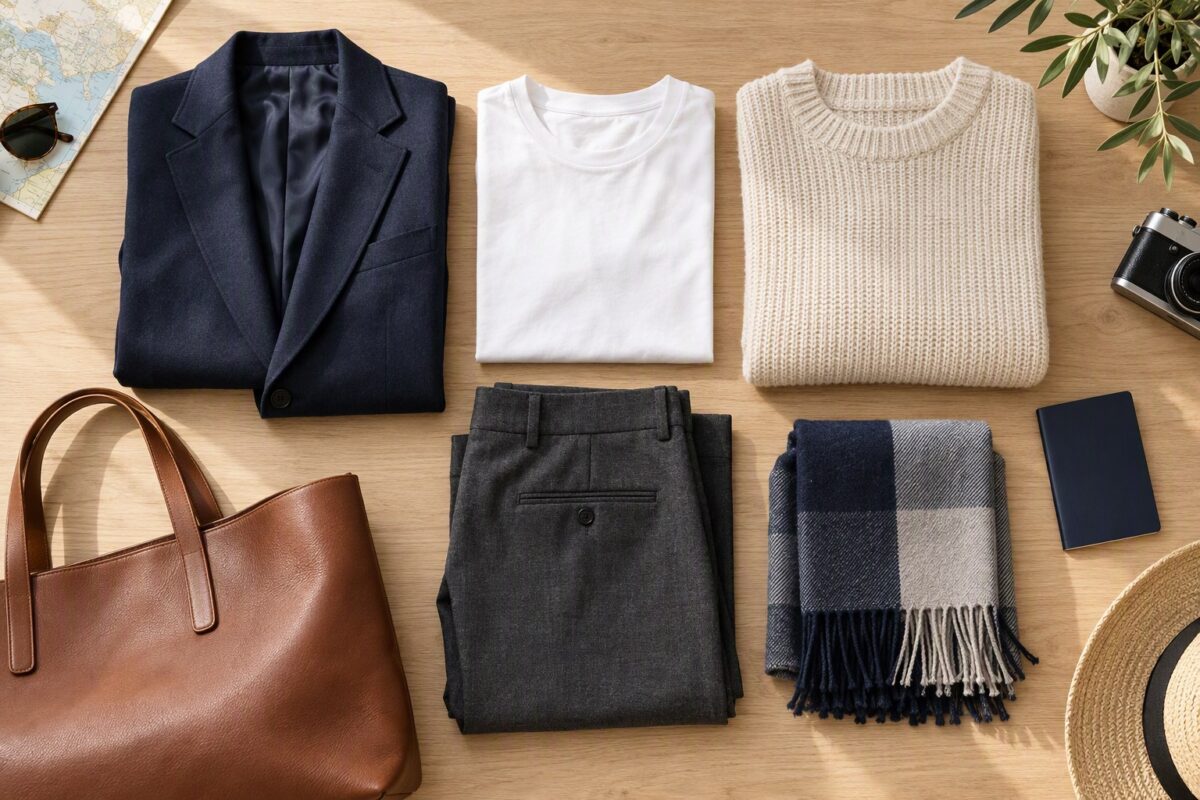
The classic travel wardrobe mistake is packing for every possible scenario instead of packing for combinations. You end up with a suitcase full of single-use outfits, and on day three you are wearing something you do not feel good in because the good pieces were used up on day one.
This guide is about building a travel wardrobe the way a stylist would: a small number of pieces that all work together, in a colour palette that removes decision fatigue, with a structure that covers every situation on your trip.
The principle: every piece must work with at least two others
Before you put anything in a suitcase, it has to pass one test: can I wear this with at least two other items I am already packing?
If a top only goes with one pair of trousers, it is a single-use item and it does not earn its space. The goal is a collection where almost any combination pulled at random is a valid outfit. That is what makes a small wardrobe feel large.
This is not minimalism for its own sake. It is the difference between packing twelve pieces and getting four outfits, versus packing eight pieces and getting twelve.
Step one: choose your colour palette
A travel wardrobe lives or dies by its colour palette. The simpler the palette, the more combinations work.
The three-colour framework
- Two neutrals as your base. Examples: navy and cream, black and grey, tan and white, charcoal and olive.
- One accent colour. Something that adds interest without clashing: a muted rust, a soft sage, a deep burgundy.
- Everything in the suitcase should fall within these three colours. If a piece does not, leave it.
This is the single most effective travel packing rule. It removes the possibility of packing items that only work with one outfit, because within a three-colour palette, almost everything coordinates.
Practical palettes by destination
- City break (autumn/winter): Charcoal, cream, and a muted rust accent. Tailored coat, fine knits, dark denim or trousers.
- Beach holiday: Navy, white, and a sand or coral accent. Linen shirts, lightweight trousers, swimwear that doubles as a top.
- Business trip: Black, grey, and a deep blue accent. Blazer, tailored trousers, crisp shirts, one pair of polished shoes.
- Active/outdoor trip: Olive, black, and a warm neutral. Performance fabrics, layering pieces, one outfit that works for dinner.
Step two: the core pieces
A travel wardrobe for a one-week trip can be built from roughly twelve to fifteen pieces, including outerwear and shoes. Here is the framework:
Tops (4-5)
- Two neutral tops that work under everything (a white tee, a fine knit, or a simple blouse).
- One accent-colour top for interest.
- One dressier option that elevates the rest (a silk blouse, a collared shirt, or a quality knit).
- One casual layer for travel days and downtime.
Bottoms (2-3)
- One pair of tailored trousers or a smart skirt in a neutral.
- One pair of dark denim or chinos for casual flexibility.
- One pair of shorts or a lighter bottom if the climate calls for it.
Outerwear (1-2)
- One structured jacket or blazer that works over every top. This is the piece that makes casual outfits look intentional.
- One weather-appropriate layer: a packable rain shell, a lightweight puffer, or a trench, depending on destination and season.
Shoes (2)
- One pair you can walk in for hours and that still looks smart enough for dinner.
- One pair for specific use: sandals for beach, trainers for hiking, or heels for formal events.
Accessories (2-3)
- One scarf or wrap that adds warmth on planes and interest to plain outfits.
- One belt in a neutral leather.
- One structured day bag that works for sightseeing and dinner.
Underwear and sleepwear
- Pack one set per day plus two spare. Use packing cubes to compress.
- One lightweight sleep outfit that is not embarrassing in a hotel hallway or shared accommodation.
The math: why this works
With five tops, three bottoms, one blazer, and two pairs of shoes, you have roughly fifteen distinct outfits before you even vary the styling. Add a scarf worn three ways, and you have twenty-plus looks from a carry-on.
That is the system. You are not packing outfits, you are packing components.
Fabric choices that make or break travel
Fabric matters more when travelling than at home, because you cannot count on ironing, dry cleaning, or a full wardrobe reset.
Fabrics that travel well
- Merino wool. Wrinkle-resistant, temperature-regulating, odour-resistant, and packs small. The single best travel fabric for knits.
- Wool blends with synthetic. Hold their shape, resist wrinkling, and are lighter than pure wool.
- Tencel and lyocell. Drape like silk, resist wrinkles, and breathe well in heat.
- High-twist cotton and cotton-poly blends. Less wrinkling than pure cotton, and they recover shape overnight.
- Nylon and technical fabrics. For outerwear and activewear, they pack to nothing and dry quickly.
Fabrics to avoid for travel
- Linen. Beautiful but wrinkles aggressively and stays creased. Save it for a destination where you can iron.
- Pure silk. High-maintenance, stains easily, and tears in transit. Unless the trip is formal, leave it.
- Pure, heavy cotton. Bulky, wrinkles, and takes a full day to air-dry if you wash it.
- Anything that needs dry cleaning. Travel is unpredictable. Do not pack clothes that limit your options.
Packing for a business trip: the specific rules
Business travel has a higher bar for presentation. The key is choosing pieces that look intentional after eight hours in a suitcase.
- Wear the bulkiest items on the plane. Blazer, coat, and the heaviest shoes. This saves enormous suitcase space.
- Pack shirts and blouses in a garment folder or roll them tightly. Rolling prevents the hard creases that folding creates.
- Use a blazer as your in-flight layer. It doubles as a blanket and arrives looking fine if you hang it immediately on arrival.
- Choose wrinkle-resistant shirting. A high-twist cotton or a cotton-poly blend shirt will look better at 6 PM than a pure poplin one.
- Bring one pair of shoes that works for both meetings and dinner. A polished loafer or a clean leather low heel covers both.
Packing for leisure travel: comfort without looking sloppy
- Prioritise fabrics that breathe. You will be walking more than usual.
- Build around one piece you love. If you have a favourite dress or a great linen shirt, make it the anchor and build the rest around it.
- Plan for the photographs. It sounds frivolous, but if you know you will be taking photos, choose colours that flatter you in natural light rather than defaulting to all-black.
- One smart-casual outfit for unexpected nice dinners. A dark trouser or skirt, a crisp top, and the shoes you walked in all day. You do not need a separate going-out outfit.
How to actually pack: technique matters
Even the best wardrobe fails if packed badly. The goal is to arrive with clothes that are wearable without a full ironing session.
- Roll, do not fold. Rolling prevents the hard creases that folding creates and saves space.
- Put heavy items at the bottom of the suitcase, near the wheels, so they do not crush lighter pieces.
- Use packing cubes to compress and separate categories. One for tops, one for bottoms, one for underwear, one for dirty laundry on the return.
- Stuff shoes with socks and small items. Saves space and helps shoes keep their shape.
- Never pack anything you have not worn before. Travel is not the time to test new shoes or a new fit.
The five things people always forget
- A top layer for cold interiors. Planes, museums, restaurants, and cinemas are often colder than the destination climate suggests. Pack one warm layer even for tropical trips.
- A repair kit. A few safety pins, a needle and thread, and a stain remover pen. They take no space and save the day.
- A swimsuit. Even if you are not going to a beach, hotels have pools and spas. A swimsuit takes almost no space.
- An extra pair of socks. Walking all day in the same socks is the fastest route to blisters.
- A lightweight scarf. It covers shoulders for religious sites, warms you on cold planes, and changes the look of an outfit for photos.
Frequently asked questions
How many outfits do I need for a one-week trip? Five to seven complete outfits is enough if they mix and match. You will likely repeat pieces, which is invisible if the palette is tight.
Is a carry-on enough for a week? Yes, for most climates and most trip types. The exceptions are formal trips requiring multiple suits, and cold-weather trips requiring bulky outerwear. Even then, wearing the heaviest items on the plane usually makes a carry-on workable.
How do I pack for two seasons? Choose a base palette that works for both, and layer. A fine merino base layer adds warmth without bulk, and a packable shell handles rain.
Should I pack for workout gear? Only if you actually plan to work out. Be honest. Most hotel gyms go unused, and the space is better spent on an extra top you will actually wear.
How do I avoid overpacking? Lay everything out on the bed first. Remove anything that only goes with one other item. Then remove one more item. You will not miss it.
Final thoughts
A good travel wardrobe is not about packing less, it is about packing smarter. A three-colour palette, pieces that all work together, and fabrics that survive a suitcase without wrinkling will get you through any trip with a carry-on and a small, versatile set of clothes. Pack the components, not the outfits, and you will always have something to wear.
